

Showing posts with label Community. Show all posts
Showing posts with label Community. Show all posts
Tuesday, 3 November 2015

Friday, 14 November 2014
Anthony and Diana join the Order of Interbeing
On September 14th 2014 Anthony and Diana from the Touching the Earth Sangha joined the Order of Interbeing in a ceremony facilitated by Sister Annabel and attended by many Order members from around the UK


Wednesday, 8 October 2014
Glastonbury Bridging the Gap
The
Touching the Earth Sangha has introduced food collection boxes at Siggy and
Jim’s barn at High Ham and at the Sweet Track Centre in Glastonbury to support
this food bank initiative.
Glastonbury Bridging the Gap
The
Glastonbury Food Bank and Shelter Pack Scheme was set up by the churches in
Glastonbury in the autumn of 2010 to provide food parcels and other essential
items to local people facing some kind of financial crisis. The parcels provide
vital support during what can be a very difficult time.
What
do they offer?
- Boxes containing food and toiletries
to help support an individual, couple or family for a week.
- Emergency shelter packs for the
homeless; containing tarpaulin, blanket and other basic supplies.
These are
intended to fill a gap until more sustained support is obtained.
Who do
they support?
- Those who have suddenly lost
their income due to sickness, redundancy or other change in circumstances.
- Those on low incomes who are
facing a sudden and unexpected expense.
- Those who have recently been
made homeless or have lost their belongings.
Their primary
focus is on those living in Glastonbury or nearby villages.
How
does it work?
Non-perishable
food items and money are donated throughout the year by local churches,
businesses, schools and other groups. Volunteers sort the donated food and make
up boxes suitable for both individuals and families.
Requests for
food are made by phone through local agencies, such as the Citizen’s Advice Bureau.
They only supply food to people who are referred in this way.
Volunteers
then shop for fresh bread, milk, fruit etc. and the parcel is delivered direct
to the recipient.
They can also
provide food items to agencies working with vulnerable adults, to be distributed
at their discretion.
Current needs to balance their store
(Sept.2014):
Tin pudding (Sponge/rice pudding/custard)
Tinned fruit
Tinned Tomatoes
Carton fruit juice (apple or orange)
Coffee (large and small)
Breakfast Cereal
Biscuits
Squash
Sugar
Jam
Toilet rolls
No fresh food please (see above),
and please ensure items are well within their use by date.
If you would like
to make a cash donation please contact glastonburyfoodbank@gmail.com or phone 07980458600. Please do not leave cash
(or cheques) in the food donation box.
Thank you!
Cultivating Peace, Joy and Stability Retreat at East Down 1st - 5th August 2014


East Down
Mist peels from
evergreen’s grip
Hills tumble out of view
Silent threats of
blackened cloud
Sangha body sits and
breathes
Drinking Dartmoor’s
sacred, savage wonder
By Sam
Sunday, 15 September 2013
Touching the Earth Sangha Retreat - East Down Centre, Dartmoor
Having just
returned from our Sangha’s third annual retreat at the scenically stunning East
Down Centre in the heart of Devon I feel the urge to write down a report before
my rapidly ageing brain cells allow the memory to drift into haziness. I did
the same last year so perhaps this will become an annual occurrence.
The Touching
The Earth Sangha is based in Glastonbury & Mid Somerset, but also includes
people from further afield. Over the past four years we have evolved into a
strongly-committed group of practitioners who feel very connected with each
other, and confident enough to share the responsibility of leading the various
Plum Village practices.
This
confidence was very much in evidence this week as the workload was shared
around with ease, and everything, more or less, ran smoothly. The pattern of
the days, common to most retreats in our tradition, was centred around the
usual practices of incense offerings; morning & evening chants; sitting and
walking meditations; chi gung & tai chi; working meditation; noble silence
and Dharma discussions. The latter including such subjects as ‘transformation’,
‘death and dying’ and ‘spiritual bypass/ deep listening’, and were shared deeply.


To add to the
mix we also watched a recording of one of Thay’s question & answer sessions
at a recent Nottingham retreat; took part in a bodywork session; and, perhaps
most moving of all participated in a ‘Truth Mandala’, based upon Joanna Macy’s
work, derived from her world-renowned ‘Council of All Beings’ workshops. In the
centre of the shrine room was constructed a beautiful fabric mandala within
which were placed four objects representing fear, grief, anger and
helplessness. We were invited to enter this space with intent to share our
emotional distress at the plight of the Earth and her environment. We could
also express our hope and belief that things would change for the better. At
times it was very moving and emotional hearing people’s anguish and pleas for
loving-kindness and compassion for the planet’s species and ecology, and those
who took part felt privileged to having done so.
It was a
privilege to be there, and everyone expressed the wish to return to East Down
again next year in order to strengthen our Sangha and deepen our connection
with each other. So my heartfelt thanks go to Collette, Sam, Kev, John S, John
H, Anthony, Diana, our super Tenzo Rose, Victoria, Jeannette, Husamadin,
Habiba, Felipe, Julia and dear four year old Tashi, without whom the retreat
would not have been as rich.
by Ark Redwood


Sunday, 17 February 2013
Sangha Woodland in Glastonbury
The Touching the Earth
Sangha has now been in existence for nearly four years. We had no idea when we
started how things would develop and what could be achieved, and what started
out as a bit of an experiment has evolved into a healthy, thriving community of
practitioners. In addition to our regular days of mindfulness and evening
meetings, we have also started a steering group to guide and develop ideas
within the group and have just booked the East Down Centre on Dartmoor for our
third annual retreat. Last year’s retreat was fully booked in twenty four
hours, so depending on what happens next year it may be time to find a larger
venue for 2014. Things have evolved very organically and naturally, with lots
of input from many Sangha members and a culture of shared ownership and
responsibility from the beginning.
I was reading ‘Friends on
the Path’ recently featuring essays by Thay and other contributors on the art
of building Sangha. In chapter 1: ‘Spirituality in the Twenty-First Century’
Thay talks about despair being the great temptation of this century, and the
need for Sangha support. We are faced with apparently overwhelming challenges
in the twenty-first century (with environmental destruction and global warming
etc) and the potential to endlessly discuss and blame, sink into despair and become
overwhelmed is indeed tempting. As a
Sangha, we can support each other and be creative in the face of all these
challenges.

What the world really
needs is love and understanding. The Earth herself needs love as well as the
people and all sentient beings living on it, and hopefully our Sanghas can have
love and understanding at their core. As the Touching the Earth Sangha has
developed over the years, I feel love and understanding is being nurtured and
is growing, and the potential within the group has grown to match.
I have been working as a
forest school leader for the last four years, and transmitting a love of nature
and our Earth is, for me, a key element of this work. Working in the woods with
small groups of children, watering the positive seeds in their consciousness
and allowing the beautiful woodland to work its magic is very rewarding. It
truly feels as if I am ‘sowing seeds’ in their minds. I don’t know how these ‘seeds’
will manifest in the future, but it fills me with optimism. I don’t know how
many children I have worked with (from one off days to more intensive six week
programmes) but it must be between 700 - 1000 children. During the forest
school sessions, I encourage the children to practice deep listening during our
sharing circles (it appears loving speech is a bit more of a challenge for
them) which take place at the beginning and end of each session. I have
introduced more meditative activities such as the ‘sound map’ which involves
the child sitting in silence in the wood listening to the sounds around them
(with their eyes closed) and then drawing the sounds on a piece of paper, with
a picture of themselves in the middle (after hearing a bell of mindfulness). The
child learns to be more receptive and in touch with what is. I’m planning to introduce a range of different mindfulness
practices.

I have had an aspiration
to buy woodland either near or in Glastonbury for the last few years as a way
of developing this work. I also thought that a woodland could become a place
for the Touching the Earth Sangha in some way. I could see days of mindfulness
happening in the woods and Sangha members having access to the woods as a
resource - to be in touch with the nourishing and healing elements that a
woodland environment has to offer. I could see a project involving the Sangha,
sharing ownership and working together. We realised we couldn’t afford this
particular dream on our own (and realised that even if we could, we didn’t want to do it on our own). So, when a
two acre woodland came up for sale in the hills near Glastonbury Tor we thought
maybe it was worth putting out the word in the Sangha to see what would
happen…..

Our group met up in LaTerre Café in Glastonbury for three meetings leading up to the auction. We managed to work out how we were going to manage the woodland if we were successful, and what everyone’s aspirations were for the woodland. We found a solicitor to write up our agreement, and a whole gang of us (eleven in total, including moral support) went off to the auction and put in a successful bid. This all happened in under four weeks from the time of discovering the woodland was for sale. From our first meeting in LaTerre until the auction itself was about a week and a half! Causes and conditions were obviously right for things to manifest.

So, in the spring I expect
I will be setting up my geodesic dome so it can become a ‘Dharma Dome’ in the
woods ready for a day of mindfulness. What could be more Buddhist than
meditating in the woods?
We have quite a lot of
work to do before that will be possible, but I’m looking forward to getting
started on improving the access and putting in a compost loo and fire pit with
seating etc. The first tree we are going to plant is a willow that was given to
me as a cutting by my good friend Chris Madelin shortly before she died. Chris
supported us when we first started the Sangha, and lead the walking meditation
on our first day of mindfulness. I see the woodland as part of her
continuation, and the tree is a continuation of a tree from her garden.

With the rapid expansion
in the number of Sanghas the last few years, there must be many interesting
‘grass roots’ projects being started by Sangha members up and down the country.
I was wondering, for example, how many Sangha allotments there are out there? It
would seem a great way to work together and produce some organic food. There
must be many new and original ways people are Sangha building in response to
the challenges of our modern lives. An interesting change I have noted in myself
is that I have moved away from the model of community where everyone has to
live together in a practice centre. The development of the Touching the Earth
Sangha has caused a dropping away of that particular idea. It’s kind of
obvious, really, that Sangha is all about people and not about anything else.
The Sangha I am part of is meeting my need, and working together we can achieve
a lot.
Kevin Bull
True Flower of Loving
Kindness

Saturday, 27 October 2012
Community of Interbeing Facilitators Retreat
COI SANGHA FACILITATORS RETREAT AT CROSSWAYS, NORTHANTS, WITH MURRAY CORKE SEPTEMBER 15-17, 2012
After a demanding four hour journey cross country from Glastonbury Diana and I joined 24 other Sangha facilitators and would be facilitators at the United Reformed Church Crossways Residential Centre in picture postcard Yardley Hastings in rural Northants.
Cambridge based Dharma Teacher Murray Corke was our facilitator and guide on this the first such facilitators weekend since 2004 and our very able Tenso in the kitchen was Lee from Nailsworth Sangha with Jenny Yeong from Oxford Sangha managing the bookings and admin. Our first practice was the Five Contemplations at our evening meal on Friday.
In our first circle for introductions and orientation it became clear that we had a wide range of experience ranging from people new to the practice seeking to set up sanghas in rural Cornwall, Monmouth and North Yorkshire to experienced practitioners in established city sanghas in Cambridge, Manchester, Nottingham, Oxford, Bristol and North London, many of whom with facilitation experience. We also attracted two experienced Mindfulness Trainers who wanted to know how to facilitate Thays practices to use in their own work!
From the opening circle Murray made it clear that although he would offer guidance and input we would gain most from sharing our experience and knowledge with each other. He also told us that he hoped we would put our names down not just to volunteer to help with food preparation and washing up but also to facilitate more and more of the outline programme and the practices as the weekend developed.
After a guided meditation and Kinh Hanh we went to bed in Noble Silence until breakfast on Saturday(after sitting, walking and sitting practice and a sutra reading)where I found myself in charge of porridge making....
On Saturday Morning we agreed to explore sitting facing the wall in traditional Zen/Plum Village style something that clearly few sanghas did regularly then Murray offered a talk on Facilitation and took questions and answers.
Murray suggested that the most valuable resource for a Sangha facilitator is a 'Second Body', someone else who will offer support and feedback to us when we facilitate especially at the beginning.
We must be willing to take the first step and be prepared to make mistakes and he reminded us of the advice he'd been given by a young boatbuilder when he was asked to do his first boat building repair job: “the reason you cant start is that you think you haven't got the experience to do the job. Just start! The only way to get the experience is to do the job”
He also reminded us that if we are stressed or preoccupied and cannot offer our full presence to facilitating the Sangha we should not be facilitating and perhaps needed to ask someone else to do it or maybe even to cancel the session if there is no one else!
Our role is not to lead or to teach but to enable..and to try and create a safe space for people to practice in...that will transmit itself to others. Sangha facilitation like the rest of our life will not always present you with what you want but over time you can gain serenity about the inevitable ups and downs.
Murray observed that creating a familiar and stable environment is important in facilitating and developing sangha not least in meditation practice. First its important to give time to preparation and ensuring personal stability. Secondly we need a suitable regular venue to settle into be it in someones home or a hall or centre.
Particularly if we are moving around a lot we need similarity of practices,candles, flowers, shrine etc. Flowers, Rupa, candles and incense can provide focus and continuity.
We may like to create an Ancestor shrine with images of family and friends we wish to honour (no living people please!). In the Vietnamese tradition Shrines should normally be slightly raised above sitters – the Buddha is our aspiration.
Murray noted the general principle of respectful/mindful behaviour thus ' the more respect you give to something the more it gives back to you' and gave examples including passing bells by lifting with both hands and passing the chanting book in both hands.
Murray gave a lot of time to exploring 'Designing a Programme' saying that it needed to be appropriate to the event and the participants. So at Woodbrooke with Quakers dont assume any knowledge of the tradition or the practice.
When there are new people we may need to go back and introduce what we are doing ideally by introducing the basic practices again to everyone rather than isolating and drawing attention to newcomers.
Murray advised that we design programs not for our own needs but for participants need so readings and guided meditations needed to be pitched at an appropriate level starting with simple guided meditations such as flower/fresh rather than some of the long and intense sequences in The Blooming of a Lotus which he considered not suitable for beginners.
He reminded us that it may be important to begin Sangha meetings by helping beginners to find a comfortable way to sit with a stable posture (with shoulders, hips and bottom in line). He commented wryly that 'beginners often think they know already when they dont!' so it may be best again to offer 'kind and diplomatic help' to the whole group rather than to newcomers.
Murray observed that the presentation of practices will inevitably vary from Sangha to Sangha and this is part of the richness and diversity of our tradition however it is important to be consistent.
He noted that Plum Village itself changes the practices a lot over time so it is certainly OK to modify practices but again maintaining a recognisable pattern and consistency is important to participants.
One way Murrays home sangha helps sangha facilitation is by having a meal together every six months to talk about sangha issues, forms of practice and organisation. Such meetings remind us that ' the essence of sangha is friendship not simply practice.'
This is particularly true in relation to 'difficult people' “Difficult people are also our practice and the underlying issue is friendship which will help to resolve issues”.
Murray reminded us that Dogen advised that 'when the opposites arise the buddha mind is lost' and he encouraged us to notice our own 'mind commentary' about what and who we consider to be difficult and easy and good and bad. While all this is going on in our heads are we really experiencing ' clear and awakened mind'?! Prevention of conflict through mindful practice and behaviour is much better than dealing with it only at a later stage when a dispute has already broken out.
Murray emphasized the important of developing co-facilitation and delegation within a local sangha. Timely delegation and inviting others to co-lead can lead to the development of new sangha co-facilitators to share the responsibility. Asking others to give a reading or a talk, or leading a guided meditation or walking practice helps them to feel trusted and valued.
Hanging on to a leadership role for too long can lead to burnout and to you becoming too controlling leading to conflict in the sangha. Then you may simply lose people in unhappy circumstances or may need to call in a skilful outside facilitator not involved in the dispute to 'Begin Anew'.
Murray highlighted his own experience of a formal Beginning Anew' process in his Sangha with an experienced outside facilitator and Dharma Teacher initiated because he felt he was being undermined as a facilitator by someone else in the Sangha. The process uncovered that the other person A identified M as a controlling parental figure whom he wanted to attack and hurt because of parental issues. The remedy? M stepped back from his leadership role and observed a low profile for some time and the conflict dissolved and A and M are now good friends.
Often it may not be necessary to have a formal Beginning Anew process to resolve Sangha conflicts. We need to use our intelligence and adapt such processes to our local situation. Murray advised that we “ facilitate with our eyes and ears and senses and be aware of whats happening in the sangha and respond appropriately. Facilitation is not about simply knowing the forms and applying them rigidly”
Murray quoted Suzuki Roshi who told his students after listening to some excruciating Japanese chanting in San Francisco ' please chant with your ears' and said “please facilitate with your ears and you'll forestall many difficulties”
During the question and answer session there were queries on:
insurance – organised retreats in the name of COI are covered but check your own house insurance for your own home.
advertising and publicity – many sanghas put out leaflets or public listings but Murray observed Cambridge Sangha 'never advertise as we believe the energy of our practice gets the word out and we do not particularly want to grow at this stage'
teaching – 'the facilitator is not a teacher but maybe some things like physical posture need to be taught.' Dont be attached to one way of doing things as the diversity of local practice is part of the strength of the COI but if in doubt follow Thay and Plum Village practice as a fallback position.
encouraging people to share in dharma discussions – 'groups can be very scary places for some people so some people will come and sit but not share. The facilitator can encourage such people by expressly inviting those who have not yet spoken in a Dharma Discussion to speak with about 10 or 15 minutes to go..'
lack of male facilitators – 'the softness and kindness of Thays teaching has a very feminine side to it which may attract women more than men. Its not something to worry about. We can of course invite regular attenders to be a facilitator and lead practices
length of sittings – 'with beginners 20 minutes may be a long sit so for regulars and for experienced practitioners in the sangha it may be valuable to organise longer sits on Sesshin (sitting/walking/sitting) or days of mindfulness'
other traditions – 'its important to keep presenting Plum Village practice but encourage people from other traditions not to give up their own practices...'
unresolved conflict – one sangha member from a large city sangha reported that conflict in the Sangha had been unresolved over a long period of time and led to people avoiding each other. Murray recommended Beginning Anew practices and the invitation of an experienced outside facilitator to help the process.
Murray then led us on an outside walking meditation to a local nature reserve where we shared Plum Village songs.
In the afternoon we had a very enjoyable Bell practice session in which everyone passed round bells of all shapes and sizes to wake up and invite and play with. This was a real confidence builder for people like me with limited experience of using the Bell in the Sangha and together we made some very harmonious and melodious sounds.
I went on from there to take over as Bell Master for Sunday from Katie from Bristol and learned the basic pattern for inviting the bell 10 times before activities.
After Bell practice Diana facilitated a deep relaxation for the whole group and two other women facilitated a Touching the Earth and after supper we split into 4 groups to have a Dharma discussion on conflict resolution. I hung back but the others were mostly inexperienced facilitators and seemed determined to have me facilitate the discussion.
I duly shared guidelines such as:
the purpose of bowing to each other when some one wanted to speak ( a mark of respect and ensuring a safe space for uninterrupted speech);
speaking from experience not second hand or abstract views or speculation;
allowing time between sharings so that we absorb what is shared and avoid debate or crosstalk and only offer feedback or advice if it is specifically requested;
confidentiality – keeping what is shared within the group and only relating personal stuff elsewhere with sharers permission. Importance of creating a safe space.
Encouraging those who haven't spoken by asking others to refrain from 2nd or 3rd helpings and inviting non-speakers to share. Reminding everyone when there is 5 or 10 minutes left that this is an opportunity for people who haven't shared to do so...
One Quaker woman in our group reminded us that the uninterrupted space is as much for listening as for speaking.
In terms of content our group spent a lot of time exploring how to deal with anger and the question of whether anger was taboo and unacceptable. We agreed that Thays own experience in Vitnam and with the Boat people has shown anger can be useful and lead to transformation but it needs to be contained and processed in a responsible way not becoming a habitual response.
We noted the cultural tendency of English people to deny or avoid the expression of anger and stuffing it down for French people to express it and indulge in it by shouting and screaming at everyone. Neither of these approaches was seen as helpful. Anger needs to be acknowledged if it is to worked with and transformed but it does not necessarily have to be let loose in its raw state...this is not mindful or creative this is simply reactive and destructive.
On Sunday different sangha members facilitated all the sessions apart from Murrays showing of a Walking Meditation DVD of Thay teaching at Green Gulch Farm in California some years ago.
Murray then had final Q and A discussion. In it he recommended materials for Sangha Facilitators as follows:
Chanting from the Heart - for basic practices and ceremonies and discourses
The COI Manual of Practice
The Heart of the Buddhas Teaching
Old Path White Clouds ( the life and teachings of the Buddha)
The World we have – a good introductory book by Thay on sustainable living; other good introductory books are – The Miracle of Mindfulness, Being Peace, Touching Peace, and Walking Meditation.
With regard to the Blooming of a Lotus Murray cautioned us to be wary of using complex deep level guided meditations with beginners – stick to the simple ones or write your own simple ones!
M could not recommend a CD or DVD containing the main chants in the Plum Village tradition (Though 'Breath by Breath' was suggested) so a search of You Tube may be required.
After lunch and clear up we departed in all directions towards our home sanghas...
I really appreciated this weekend not simply for Murrays wise and astute facilitation but also for the opportunity to meet so many men and women ( 18 women and 8 men) from sanghas across the country, large and small and to compare resources and experiences and practices within the grass roots of our movement.
Anthony
Tuesday, 21 August 2012
Bare necessities, learning to breathe as one body
 |
| The Touching the Earth Sangha Retreat August 2012 |
Having just got back from a retreat with my local Touching
The Earth Sangha, (based in Glastonbury & Mid Somerset) I felt I had to
write about the experience because it was a powerful time for everyone there,
and helped to deepen our practice, and commitment to each other.
This was our second organised retreat as a Sangha, and was
based, once again, at the excellent East Down Centre situated on the northeast
fringes of beautiful Dartmoor. It is a perfect place for a retreat, possessed
with first class facilities, plus exceptional views across the wooded valleys,
and a lovely walk down to a nearby lake.
Our Sangha is very strong and growing well. We currently
meet on the second and last Monday in the month, and hold Days of Mindfulness
every six weeks or so in a wonderful barn a few miles from Glastonbury. We have
been in existence for over three years now, and look forward to a positive
future.
There were seventeen participants on the retreat, including
three year old, Tashi, a key member of the Sangha, who is much-loved by all. He
is particularly skilful at stimulating our chuckle chakras! He also teaches us
how to really be in the present moment, and to get in touch with our playful side.
He particularly enjoyed being serenaded by the mass Sangha choir with a
spirited rendition of ‘Bear Necessities’, a tune which I am now having trouble
dispatching from my brain!
The rest of the schedule consisted of the customary
practices of sitting & guided meditations, kinh hanh and outdoor walking
meditation, deep relaxation, touching the earth, qi gong, and working
meditation. We held Noble Silence from the end of the evening schedule until
the following day’s lunchtime. We all relished this opportunity to dwell within,
yet focusing mindfully on the task or activity at hand.
In the afternoon we had the chance to check in with each
other for our afternoon Dharma discussions, and this became fertile ground for
sharing deeply our inner worlds and opening ourselves up within a safe space.
We all felt secure enough within the Sangha to really be genuine about how we
were feeling, dealing with the stresses and strains of our life stories, and
this resulted in an often profound sharing between people, and many commented
that they had not felt safe enough in other groups to express how they truly
felt. We all felt this was testament to the strength of our brotherhood and
sisterhood in the Dharma. It was very moving at times, and I, personally, felt
touched by people’s emotional honesty and willingness to trust the process, and
to feel safe in the telling.
On the Saturday, in the evening we held a New Moon
Celebration where poems were recited (either by Thay or self-penned), songs
were sung, games were played and we also were taught how to make lotuses out of
crepe paper, into which were placed candles and these were then slowly paraded
outside in procession while we chanted ‘Namo ‘Valokiteshvara’ across the grass
to a waiting fire. The lit lotuses, of various colours, were placed beautifully
in a circle around the fire and we then deposited slips of paper into the fire
representing anything we wished to let go off or cultivate within ourselves. It
was a lovely way to end the day.
On the final morning we gathered together in the Dharma Hall
for our final sharings, before finishing with another sumptuous meal lovingly
prepared by our ‘Super Tenzo’
Rose. Then, reluctantly, we had to admit that the retreat was indeed
rapidly drawing to a close, and we began to pack our bags accompanied by much
hugging and determination to return again the following year. We all knew we
had been part of a special event, and it only served to draw us even closer
together as a Sangha. Roll on next year!
by Ark Redwood
by Ark Redwood
Friday, 10 February 2012
Full Moon Retreat 2011


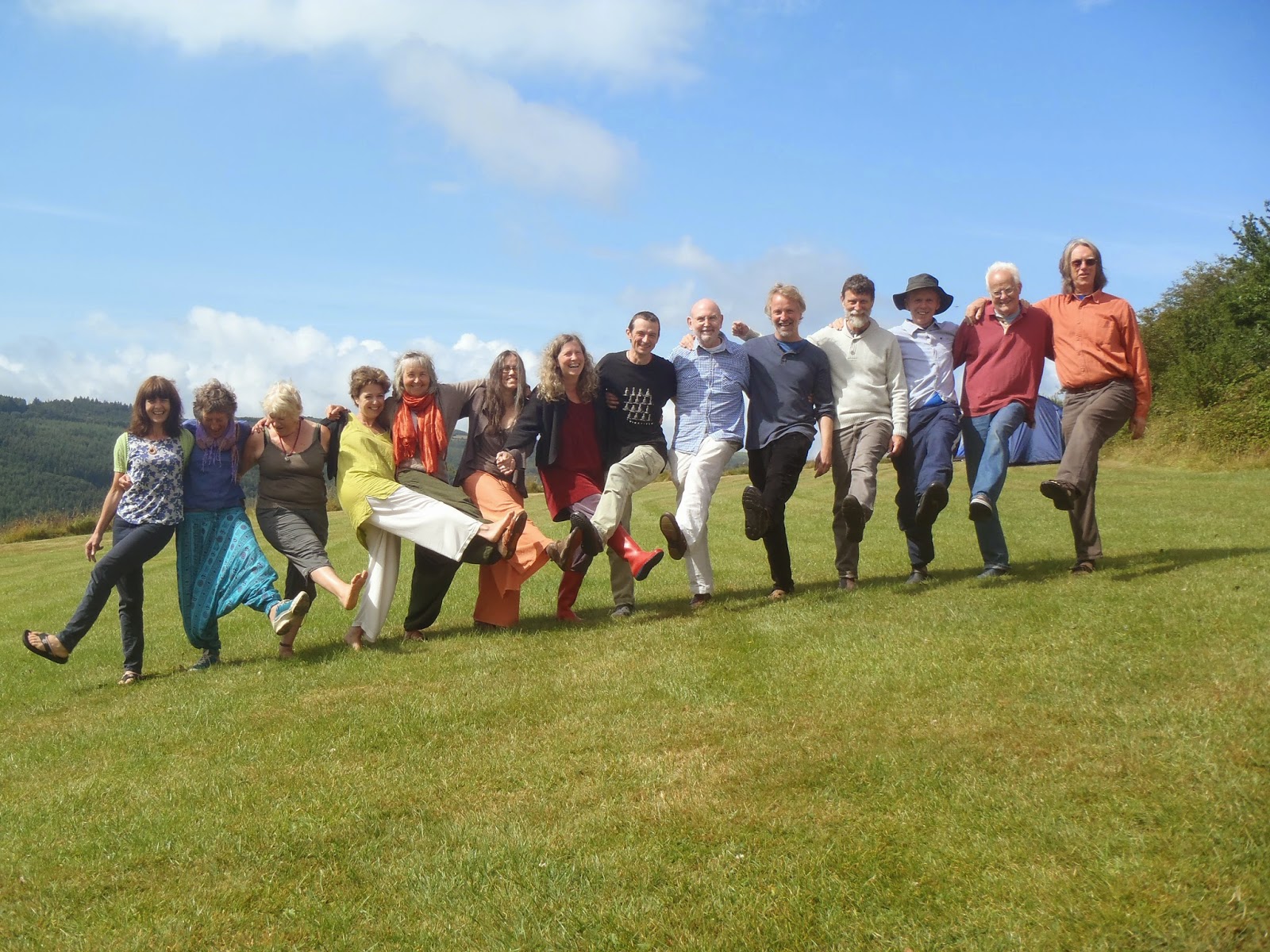
Here we are, our Sangha at East Down Centre for last year Full Moon retreat. Right now we are working on this year retreat, so keep updated and hopefully you can join us!

Subscribe to:
Posts (Atom)